

Level-Sill Spillways in Permaculture: Sustainable Water Management for Resilient Landscapes


Introduction to Water Management in Permaculture
Permaculture design starts with water, access, and structures, making water management the foundation of sustainable landscapes. By understanding how water moves through a site before and after earthworks, we create systems that work with nature. The permaculture mantra of "slow it, spread it, sink it" guides us to hold water high in the landscape, store it in soils and vegetation, and capture surplus in swales, terraces, half-moons, or dams for use during dry periods for livestock water, gardens and tree systems/orchards .
Level-sill spillways are a simple yet elegant solution to manage water overflow, ensuring it leaves passively to prevent erosion. Drawing on my extensive experience in permaculture design working in different climate zones, in projects across Australia, Morocco, and beyond, this article shares my approach to designing and constructing level-sill spillways. Whether you’re a homeowner or a farmer, these insights can transform your site into a resilient, water-wise landscape.
What Are Level-Sill Spillways and how are they used in permaculture design for Sustainable Water Management for Resilient Landscapes

A level-sill spillway is a long, dead-flat (on-contour) bench cut into the original ground for swales or dams, or constructed with rock armor for terraces. It handles water overflow, directing surplus water passively to downstream features like ponds or additional swales without causing erosion. Unlike conventional engineering spillways (e.g., ogee or chute spillways), which concentrate flow through pipes like a jet, level-sill spillways prioritize sustainability, simplicity, and integration with natural systems hence article title Level-Sill Spillways in Permaculture: Sustainable Water Management for Resilient Landscapes.
Calculating Spillway Length for Maximum Rain Events
To design a spillway that can handle a maximum 24-hour rain event, calculate its length based on the catchment area. For example:
Catchment Area: 1 hectare (10,000 square meters).
Maximum Rainfall: 100mm in 24 hours.
Water Volume: 10,000 m² × 0.1 m = 1,000,000 liters.
Hourly Flow: 1,000,000 liters ÷ 24 hours = 41,666.67 liters/hour.
Minute Flow: 41,666.67 liters ÷ 60 minutes = 694.44 liters/minute.
Second Flow: 694.44 liters ÷ 60 seconds = 11.57 liters/second.
Spillway Flow: Spread over a 1-meter spillway, this equals 23.14 mm/second of water depth.
This shows that a well-designed spillway can manage large volumes passively, reducing erosion risks. For help calculating your site’s needs, schedule an online consultation.
Why Level-Sill Spillways Stand Out
Unlike pipe-based systems that concentrate water and risk erosion, level-sill spillways spread water evenly across a wide, flat surface. This passive approach uses natural materials like earth or rock, aligning with permacultures focus on ecosystem-friendly design.
Designing and Constructing Level-Sill Spillways
Designing level-sill spillways requires precision and adaptation to the landscape. Below is my process, refined through global projects, including the Laurent Project in Morocco.
Key Design Principles
Contour Accuracy: Spillways must be on contour for even water flow. I establish a datum point using a laser level, guiding all earthworks. Excavation occurs below this height, material is built above, and the spillway is set at this exact height.
Vegetation Below Spillway: Ensure the exit area is well-vegetated to prevent erosion as water flows out.
Material Selection: For swales or dams, cut spillways into original ground. For terraces, use 75–100mm rock armor. In abrasive granite-based soils with high quartz content, extend spillway length to reduce wear.
Insurance Spillways: Add a secondary spillway at the same height or 50mm above the datum for extra capacity.
Construction Process
Survey the Datum Point: Mark the contour line across the site to guide swale, terrace, or dam placement.
Excavate the Spillway: For swales or dams, cut a 1m-wide bench into original ground at the datum height, with length based on water volume and soil type.
Construct Terraces with Rock Armor: For terraces, as an example create a 300mm tilt into the hill (150mm water storage, 150mm freeboard). Build the spillway by compacting fill, cutting to the datum height, and lining with 75–100mm rocks, extending a rock apron to vegetated ground.
Test and Adjust: Observe water flow during and after rain, adjust if needed. Water is the ultimate leveler you will see if there needs any adjustments to the spillway.
Level-Sill Spillways for Terraces
I’ve shifted to designing terraces over swales in many contexts for better access and interaction, as discussed in my blog To Swale or Terrace or Both and Why. For terraces, spillways are built with compacted fill and rock armor:
Set terraces with a 300mm tilt for 150mm water storage and 150mm freeboard. my general formula for terraces.
Create a spillway with compacted fill, cut to the datum height, and lined with rocks, extending an apron to protect the terrace mound.
This ensures passive water flow during large rain events, safeguarding the watershed.
Need help designing your spillway? Book an on-site consultancy or installation to get it right.
Benefits of Level-Sill Spillways
Level-sill spillways are essential for resilient permaculture systems, offering:
Passive Water Management: Spreads water to prevent erosion and protect downstream areas.
Cost-Effectiveness: for swales and dams there's no material brought on to the site.
Maintenance and Interaction
Ongoing maintenance ensures spillway effectiveness:
Vegetation Management: Trim vegetation at the spillway to maintain freeboard, especially with terraces or any works that have a low amount of freeboard.
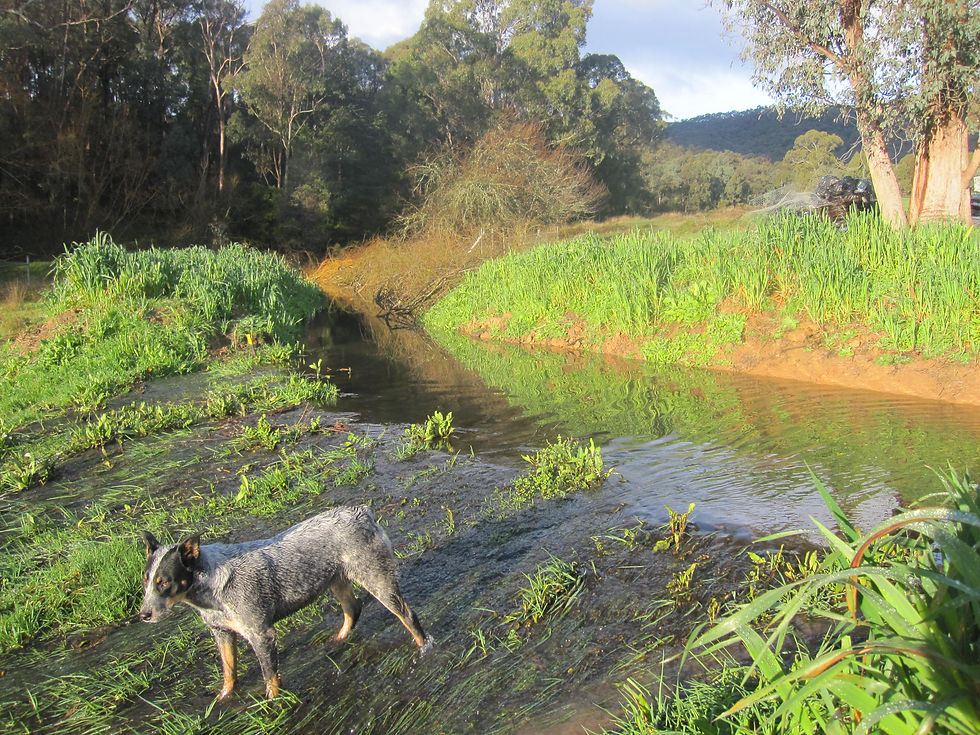
see how passive the water exits and how vegetation can chock spillway exit Observation: Check spillways post-rain to confirm level flow and adjust if necessary.
Learning Opportunities: Good access, a benefit of terraces, encourages interaction and learning. Regular engagement with your system deepens your permaculture knowledge.
Case Studies: Level-Sill Spillways in Action
A project in south coast NSW: I installed a level-sill spillway as part of a crossing dam, providing all-weather access and creating a wildlife habitat for ~$2,500 [although that was quite a few years ago now] the cost was actually the same cost for pipes that where installed and had already eroded, this won the admiration by local landcare officer due to the change in species from dry eucalypt forest to rain forest species, all by planting the rain.
crossing dam with level-sill spillway
Conclusion and Call to Action
Level-sill spillways coupled with rainwater harvesting via swales or terraces embody permaculture’s "slow it, spread it, sink it" principle, managing water sustainably to prevent erosion, recharge groundwater, and enhance biodiversity. Whether you’re designing swales, terraces, or dams, these spillways ensure your landscape thrives through any rain event. With my experience across global projects like the https://permacultureglobal.org/post_projects/6550 Project in Morocco, I can help you implement these systems effectively.
Ready to transform your landscape? https://www.docspice.life/book-online consultation for personalized permaculture design guidance from anywhere in the world. For hands-on support, schedule an on-site consultancy or installation to bring intelligent design and precise earthworks to your site. Contact me at david@docspice.life or visit Doc Spice Permaculture to start building a resilient, water-wise landscape today.
Other articles of interest
and colaborative article here https://www.plantforchange.org/sow-grow/why-we-plant-the-rain-waters-essential-role
Key Features of Level-Sill Spillways
Feature | Description |
Definition | A flat, on-contour bench for controlled overflow from swales, terraces, or dams. |
Primary Function | Manages overflow passively, directs water to downstream features. |
Materials | Earth (swales/dams), rock armor (terraces), prioritizing sustainability. |
Design Focus | Contour accuracy, freeboard security, vegetated exit. |
Benefits | Erosion control, groundwater recharge, biodiversity support, cost-effectiveness. |

Comments